Monday, August 16, 2010

Fri August 6: TRAVEL TO ZANZIBAR


6:00 am: Breakfast and prepare to leave SUA

7:00-11:00 am: Travel from Morogoro to Landmark Hotel, Dar es Salaam
Once at the hotel we unpacked some of our things to make our bags light enough for the short flight to Zanzibar.


11:15 am – 12:30 pm: Control and prevention of human and bovine tuberculosis in people
Presenter: Sayoki Mfinanga, Medical Research Scientist, National Institute Medical Research, Dar es Salaam, Tanzania 
Mfinanga discussed his research to understand the role of bovine tuberculosis in the human TB epidemic in Tanzania. He discussed current programs (COMDOTS) and other efforts to control TB and highlighted the current state of our knowledge regarding the role of zoonotic TB and other zoonoses in human populations in Tanzania. 


12:30 pm:  Lunch

1:30 pm: Travel to Dar es Salaam international airport

3:40 pm: Flight Dar to Zanzibar (Precision Air Flight 713)
This was by far the shortest flight I have ever been on. I sat with Kemi (Nigeria) throughout the 15-minute journey. 


4:10 pm: Arrive Zanzibar and settle into lodgings

6:00-7:15 pm: Conservation of endemic species and their landscapes in Zanzibar
Presenter: Kirsten Siex, Assistant Director Africa Programs & Director Zanzibar Program, WCS
Seix introduced us to the major objectives of the WCS Zanzibar Program, and talked about their efforts to conserve the endemic red colobus monkey and Ader’s Duiker, and the habitat they need to survive. Previous colobus health research and ecotourism challenges were discussed.   


7:30 pm: Dinner  - Chinese Restaurant (Tricia’s Birthday)
We took over the back room of a dark Chinese restaurant in the middle of Stone Town. The instructors ordered a bunch of food for each table and I tried everything. It was similar to the Chinese food at home but maybe a bit more authentic. Unfortunately, before Tricia’s birthday cake was brought out Amelie (Canada) began to feel quite sick. She was overheating, swelling up in her face, crying, and feeling quite thirsty. After a quick celebration our entire group headed back to the hotel. As keeper of the groups medical kit, I rushed up to my room to bring the box down. No one knew quite what was wrong but we all suspected a food allergy. After trying to consult with physicians back home, we were all amazed when Val ran down from his room with the diagnosis. He read off a list of symptoms (of which she had all of them) and determined that she had Chinese Restaurant Syndrome – or MSG toxicity.


Once things seemed to be settled (10ish) Amanda (Colorado) and I tried to go find an internet café. Incredibly, all of them seemed to be closed. Instead we went back to the hotel for an early night.

Thur August 5: HEALTH AND POLLUTION LABORATORIES

HAPPY BIRTHDAY TO MY SISTER LAUREN! 
 7:00 am: Breakfast


8:00 am-12:00 pm: Focused Sessions on Health and Pollution
Session One: Using Biomarkers to Assess Environmental Pollution in Tanzania
Instructor: Robinson Mdegela, Senior Lecturer, SUA & Hezron Nonga, PhD Student, SUA
Mdegela, an Envirovet 2008 alumnus, described his research assessing biomarkers for pollutants in the widely distributed African sharptooth catfish. We had a chance to examine the catfish as they are used in the conduct of ecotoxicological testing. Sadly, all of the fish that we were going to use died the night before from a fungal infection. Thus, before starting the lab, we had to make a trip to the lake to pick up more catfish from the local fishermen. 


12:30 pm: Lunch
Just before lunch started we were warned that Tanzanian immigration officials were on their way to inspect our visas. Apparently some of the envirovets have the wrong visa type so we spent quite a while trying to evade the officials (successfully!). Because my visa was the correct type I tried to sneak off and use the internet for a few minutes. Unfortunately, it was so slow that the only thing I was able to do in the 30 minutes that I was on the computer was send and email to Jackie that I was still alive. 


2:00-6:00 pm: Session Two: Avian Influenza and Village Poultry Health-Group
Instructor(s): Armandus Muhairwa, Senior Lecturer, SUA  
The potential impact of and possible entry points for Highly pathogenic avian influenza (HPAI) in Tanzania were discussed. Surveillance limitations for HPAI in developing countries was addressed, and a new initiative to create Village Biosecurity through improved poultry health was highlighted.  During laboratory we i) learnt  proper handling of chickens, ii) appropriate biological sampling techniques for HPAI testing, iii) how to use and interpret the rapid influenza test, and iv) were taught how to minimize virus contamination during processing for food consumption. Community benefits of poultry farming were also highlighted. Regrettably, this was the least enjoyable moment of envirovet for me. I did not enjoy the lecturer and got somewhat irritated during the lab when I did not have the opportunity to do some of the things that I wanted to. 


7:30 pm: Special Dinner Out
We were treated to Pizza and beer at a local restaurant. I played billiards on and L-shaped table with some of the guys and Andrea (Illinois) while most of the girls danced. 

Wed August 4: SOKOINE UNIVERSITY- ZOONOTIC DISEASE AND VETERINARY EDUCATION


7:30 am: Breakfast
8:30-8:45 am:  Introduction and Welcome to Sokoine University of Agriculture
Presenter: Philimone Wambura, Dean, SUA Veterinary School 


8:45-9:30 am: Veterinary Education in Tanzania:  Roles of the public and private sector
Dominic Kambarage, Deputy Vice Chancellor of Academic Affairs, SUA
Kambarage explained the history and current capacity for veterinary education in Tanzania, with references to current employment options in the public and private sectors. Challenges to the delivery of veterinary services and veterinary education were also discussed. 

 9:30-10:15 am: Rift Valley Fever: Lessons from the 2007 outbreak, health significance, and implications of climate change
Presenter: Rudovick Kazwala, Prof. of Veterinary Medicine & Public Health, Envirovet Tanzania Co-director, SUA
Rift valley fever is a viral disease transmitted by contact with blood or tissues as well as via insect vectors that commonly bite animals and humans. The disease most often occurs following rainfall exceeding normal amounts in areas where the virus and insect vectors are available. The importance of the disease arises from the fact that it affects animals and humans causing massive losses directly through deaths and indirectly through reduction of productivity.  RVF occurred in Tanzania in 2007 with mortalities in both human and animal populations. Linkage of occurrence of RVF and climatic changes were discussed.

10:15 am: Tea


10:45 am-12:00 pm: Tour of Sokoine University Veterinary School 
Leaders: SUA Veterinary Faculty Members, Graduate Students, and Staff
We toured the small and large animal clinics, rabies isolation unit, anatomy and pathology facilities, animal areas, instruction facilities and the Mycobacterium laboratory. 

12:30 pm: Lunch 


2:00-5:00 pm: Innovations in Disease Diagnostics for the Developing World:  Tour and demonstration of APOPO Vapour Detection Technology  
Leaders: Apopo staff
APOPO trains groups of sniffer rats to detect explosives and also to diagnose disease. This innovative idea has been developed into a competitive technology by a group of Belgian and Tanzanian researchers and animal trainers. We visited the APOPO facility to hear more about this unique program and to see a demonstration of the sniffer rats trained to detect tuberculosis in sputum samples.  


5:00 pm: Tea
5:30- 6:30 pm: Case Study: Chytrid Fungus and the Population Collapse of the Kihansi Spray Toad
Presenter: Gerald Misinzo, Lecturer, Faculty of Veterinary Medicine, Sokoine University of Agriculture

The Kihansi Spray Toad (KST) is a diminutive, ovoviviparous Bufonidae, endemic to the Kihansi gorge, located within the Udzungwa mountains in Tanzania. Diversion of the Kihansi river in December 1999 for the Lower Kihansi hydroelectric project reduced the river flow and destroyed toad habitat. In fear of extinction of KSTs, a few KST were translocated to Toledo and Bronx zoos in the United States. Since 2004, no KSTs have been sighted in Kihansi gorge spray wetlands. One of the key factors presumed to have caused the disappearance of KST in the wild is an outbreak of chytridiomycosis. Chytrid fungus infection of KST causes 100% mortality. Survival of KST in chytrid fungus-contaminated Kihansi gorge is possible if KST were resistant to chytridiomycosis. Misinzo described efforts at SUA to develop biological control of chytridiomycosis in KST as there are no known chemical control measures of the disease in the wild.  A program to reintroduce toads captive bred in US zoos back to Tanzania was discussed. 


6:30 pm: Dinner

7:45-8:30 pm: Small Animal Practice and Animal Welfare in Tanzania
Presenter: Armandus Muhairwa, Senior Lecturer, SUA 
Muhairwa discussed the current state of companion animal veterinary medicine and welfare in Tanzania. Most common diseases diagnosed in primary cases were discussed as how they reflect the owner’s small animal disease, nutrition and welfare awareness. Animal welfare education at the Faculty of Veterinary Medicine and the need of extending the education to the public as ways of improving welfare and care of small animals belonging to native Tanzanians was also covered. 

Tue Aug 3: UDZUNGWA MOUNTAINS NATIONAL PARK

7:00 am: Breakfast  (have luggage packed and ready by 7am)

7:30 am: Travel to Udzungwa NP headquarters for brief orientation


8:00 am – 12:30 pm: Sanje Falls Hike Udzungwa Mountains National Park
Leader: Rukia Mallya, Tourism Warden, Udzungwa National Park, TANAPA
Mallya and her staff led the group on a 7 km round trip hike to experience Udzungwa NP by foot. We had the chance to see Sanje falls and view some of Udzungwa’s 12 primate species, birds, butterflies, and forest vegetation types. The views were spectacular and the swimming holes were amazing. The only disappointing moment came when Wilson (Tanzania) killed a snake that was on the path when it was not necessary to do so. 


12:30 pm: Lunch (Twiga Hotel)


1:30-3:00 pm: Discussion: Ecology and conservation of Udzungwa Mountains National Park
Presenter: Paul Banga, Chief Ecologist, Udzungwa National Park, TANAPA
Mr. Banga highlighted the ecology and conservation history of Udzungwa NP, part of the Eastern Arc, a fragmented range of mountains containing relic rain forest stretching from Southern Kenya through Southern Tanzania. The park is a World Biodiversity Hotspot and a WWF Ecoregion of global critical importance. Although the Eastern Arc Mountains cover less than 2% of Tanzania’s area they hold 30-40% of the country’s plant and mammal species, many of which are found no where else on Earth. Conservation challenges, the cultural and economic importance of UMNP to surrounding communities in the park, and community conservation were discussed. 


3:00 pm: Depart UMNP for Sokoine University of Agriculture (SUA), Morogoro
For the first time since we got to Africa things did not go entirely smoothly. The laundry service at the hotel caused a huge problem for everyone. They charged an insane fee (over $1 just to wash a pair of socks), used markers that bled onto peoples clothes, and mixed up everyone’s laundry. While most people were getting quite upset, I found it quite funny that there were several pairs of underwear that people were too shy to claim…


7:30 pm: Dinner and settle into lodgings in Morogoro 


For the first time in many weeks we each have our own rooms! It is nice to have a bit of personal time to catch up on things like this blog! 

Mon Aug 2: COMMUNITY HEALTH AND ZOONOTIC DISEASE

7:00 am: Breakfast
7:30 am:  Depart for Ifakara


8:30am-12:00pm: Ifakara Health Institute (IHI) Visit
Leads: Mr H. Urassa, Dr. Boniface Jullu and IHI Staff
IHI is an autonomous, non-for-profit organization registered in Tanzania dealing with health research. The mission of IHI is “to develop and sustain a district-based health research and resource center capable of generating new knowledge and relevant information for public health policy and actions. We were taught about health interventions in the community for malaria, TB and HIV and tour the IHI laboratories. Innovative approaches to HIV control, including incentivizing (paying) people to stay disease-free were discussed. I found the most interesting part of the tour to be the mosquito farm, where they raise mosquitoes for malaria research. 


12:30 pm: Lunch in Ifakara

1:30-2:30 pm: Bovine Tuberculosis in Africa
Presenter: Rudovick Kazwala, SUA
Prof. Kazwala explained the history of bovine tuberculosis (BTB) in Africa and detailed
what we know to date regarding the significance of BTB in wildlife, livestock and human
populations. He highlighted current BTB research projects in Tanzania and discussed the
development of the African Bovine Tuberculosis Network.


2:45 – 3:45 pm: Rabies in Tanzania: Initiatives to control rabies for improvement of human and animal health
Presenter: Rudovick Kazwala, SUA
Kazwala provided an overview of the impact of rabies in developing countries and
highlighted an exciting new initiative aimed at eradicating rabies from Tanzania. 


4:00 – 5:30 pm: Case Discussion: Integrated Ecosystem Management of the Kilombero Valley Floodplain Ramsar Site
Presenter: Panteleo Munishi, Professor of Forest Biology, Faculty of Forestry and Nature
Conservation, SUA
In 2000 Tanzania ratified the Ramsar Convention of Wetlands, which stipulates wise use of wetland resources, maintaining the ecological character of the site while contributing to people’s livelihoods. Munishi discussed his work in the Kilombero Valley Floodplain Ramsar site, which contains nearly 75% of the world’s population of wetland dependent Puku antelope. We got to view the wetlands and discuss the issue of agricultural conversion for biofuels.  


5:45 – 6:45 pm:  Travel back to Udzungwa Dipa Lodge
7:00 pm: Dinner (Dipa)


Evening: After watching an absolutely stunning sunset, I went swimming with a few of the other students in the gorgeous pool before heading to bed.

Sun August 1: TRAVEL DAY: RUAHA TO MANG’ULA


8:00 am: Breakfast and prepare to leave Ruaha 

9:00 am-12:30 pm: Travel from Ruaha to Iringa 


12:30 pm: Lunch at a country club with no golf course


1:30 – 8:00 pm: Travel from Iringa to Mang'ula  


8:00 pm: Settle into lodgings (Udzungwa Dipa Lodge)
We are the first guests ever to stay at this new lodge. In a sense, we are their beta testers. It is definitely the nicest place we will stay during our time in Africa. 


9:00 pm: Dinner 

Sat July 31: PARKS AND COMMUNITIES


7:30 am: Breakfast

8:00- 9:30 am:  Common ground through sport - Football match between Envirovet 2010 and Ruaha Management Team            

We got a chance for some exercise in this team-building activity for Evet and Ruaha staff. It was a fairly competitive match but the other team had quite a bit more talent than the E-vets. In the end we lost 1-0. Still it was great to run around and get some exercise. 


9:30 am: Tea


10.00 am - 11.00am:  Environmental Education Program for primary schools pupils
Leaders: Education/Outreach warden and teachers.  Presenters: Msembe Primary School Pupils (Standard 5-7 grades)

Students presented poster presentation on Wild animals, Water and Forests management and related challenges in and around Ruaha National Park.  We got to discuss the park’s education program for its residents and neighboring communities.  


11:15am- 12:00pm:  Traditional dance by Msembe primary school students
The children preformed a beautiful dance and some of our female envirovets joined them in the festivities.


12:30 pm: Lunch


1:30 – 2:50 pm: Engaging communities to improve conservation
Leader:  Charles Ngendo, Outreach Warden & John Nyamhanga, Protection Warden, Ruaha NP, TANAPA
Ngendo and Nyamhanga provided an overview of the community engagement, Park outreach programs to benefit neighboring communities and the law enforcement program to prevent poaching in the park. We discussed Tanzanian policy in regards to poaching and law enforcement challenges. 


3:00 pm- 3:40 pm: Threats from Unmanaged Fire in the Ruaha Ecosystem 
Presenter: Ole Meing’ataki, TANAPA
Meing’ataki described the impact of fire on the health of the Ruaha ecosystem, and detailed efforts to research the effects of fire and create a fire management regime. 


4:00 – 6:15 pm: Evening Game Drive
The highlight of the game drive was a massive pride of lions. There must have been about 30 of them lounging about. Of course we also saw impala, giraffe, elephant, baboon, and a variety of birds. Also of interest was a dead giraffe on the side of the road on the way home that was being scavenged by a few jackals (sorry they asked me not to post pics of the dead animal). 


7:15 pm: Closing Dinner/campfire and celebration with park personnel
After our fantastic dinner around the campfire we were invite to a local wedding for one of the park rangers. Apparently the program helped to provide a DJ in exchange for allowing us to take part in the cultural experience.


 It was the strangest wedding I have ever been to. There were male strippers and clowns. Val, Alex, and Meing’ataki all gave speeches even though Im not sure they knew any of the participants. Once dancing broke out I had to rescue many of the female envirovets from over aggressive locals. Ohh and the bride seemed to be pregnant and not at all happy about the proceedings…In all it was a surreal experience that is very difficult to explain. 


Fri July 30: RUAHA NATIONAL PARK

6:30 am: Breakfast
8:00 am-2:00 pm: Field immobilization of free-ranging African wildlife 
Instructors: Epaphras Alex and Donald Mpanduji leads

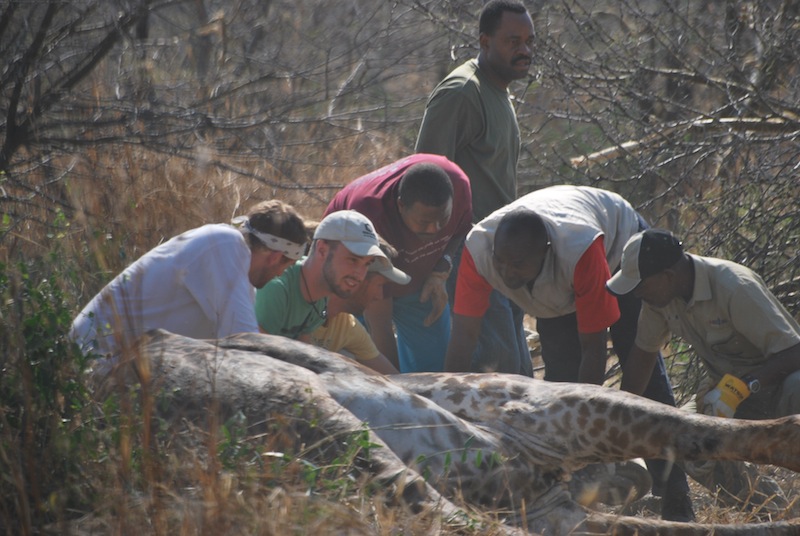
We assisted with the immobilization of wildlife species as determined by the lead veterinarian. I was on the roping team along with Jon (New York), Nate (California), Albert (Tanzania), Wilson (Tanzania), Vincent (Canada), David (India) and a few other locals who’s names I don’t remember.
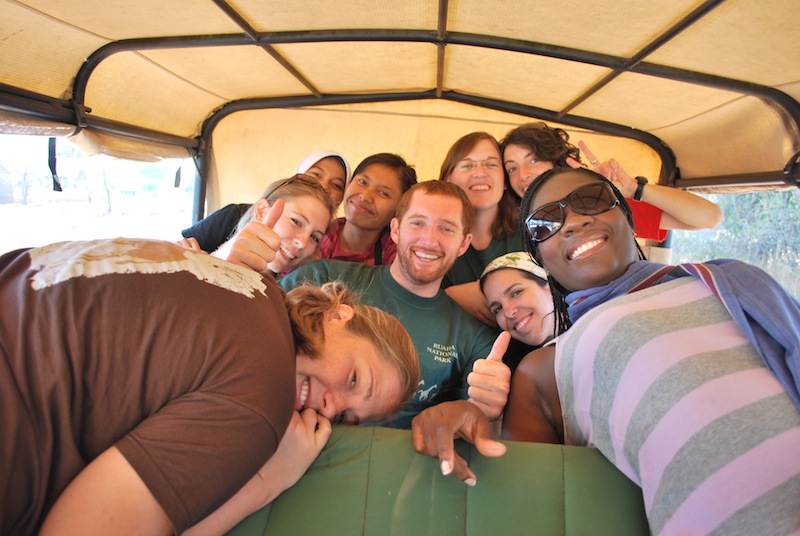
Before heading out we had to practice our roping technique. After only two practice runs we went into the field. Nine of us were packed into a land rover. Needless to say, it was very hot and uncomfortable. It took only 30 minutes to find an affected giraffe (a large bull) in a suitable location. The darting team took the lead and fired their shot. We then waited, and waited. Eventually the giraffe started to wander towards a herd of elephants. Because elephants are so dangerous our car was charged with chasing the herd away. We zoomed off-road and behind made as much noise as possible while the elephants ran.

By the time we had completed our task, the giraffe was looking wobbly and a different team decided to try to rope it. As our car sped toward the action we watched as the roping team was dragged behind the large animal. We sped by the action and attempted to position ourselves where we would be able to catch up with the other ropers. Unfortunately we hit a ditch and the car stalled out. Moments later the wobbly giraffe stumbled along just a few feet from the vehicle. It was quite scary as I imagined the animal falling onto the SUV and crushing all of us. Once the danger passed we jumped out and assisted in bringing down the giraffe.


Once down we roped the legs and the sample team came in to do their jobs. In total the animal was down on the ground for only about 10 minutes. When the giraffe was gone all of the teams gathered to discuss the procedure and prepare for the next immobilization.

The second giraffe was even larger than the first. Though he was darted without any complications, the drugs did not seem to have any effect on the animal. We waited in the hot car for an hour and it seemed as though the giraffe was still wide awake. The lead veterinarian then decided we might was well try to rope it.

On our first attempt I was one of the people charged the rope in front of the giraffe. It was one of the most exhilarating experiences ever. Up close, giraffes are so incredibly large! Unfortunately, the bull was still much to strong for us to bring him down. He pulled free of our ropes each and every time. We chased the giraffe for close to an hour before the veterinarian decided to give another dose of the immobilizing drug (M99 – Etorphine). 


Almost as soon as the dart was delivered the animal began star-gazing (head up to the sky) and having severe wobbles. The ropping team scattered as it became apparent the giraffe was going down on his own and no one wanted to be crushed. Luckily the animal fell on a barren piece of dirt and we were able to get our ropes around the legs. The rest of the procedure went smoothly and the giraffe was ok. 

2:00 pm: Discussion of field exercise

3:00 pm: Tea and snacks


3:30-4:30 pm: Elephant Conservation in the Selous-Niassa Wildlife Corridor
Presenter: Donald Mpanduji, Senior Lecturer, Faculty of Veterinary Medicine, SUA
The Selous-Niassa wildlife corridor is a landscape linkage between Africa's largest protected areas: the Selous Game Reserve of Tanzania, (a UNESCO World Heritage Site and home to Africa's largest elephant, buffalo, sable and other wildlife populations) and the Niassa Game Reserve of Mozambique, which is renowned for its large elephant population. Dr. Mpanduji detailed his research investigating elephant movements in the Selous - Niassa wildlife corridor, and discussed implications of his work and the challenges associated with transboundary conservation. 


4: 45 – 6:00pm: Wildlife Diseases and Conservation in Tanzania
Presenter:  Robert Fyumagwa, Veterinary Research Officer, Tanzania Wildlife Research Institute (TAWIRI)
Fyumagwa, an Envirovet 2002 alumnus, discussed his responsibilities as a veterinarian and researcher for TAWIRI.  He shared how Envirovet has shaped his professional experiences and how he has put his Envirovet training into practice. He also highlighted current research priorities. 


7:00pm:  Dinner
Evening: It was an early night for everyone as we were all exhausted from wrangling giraffes.